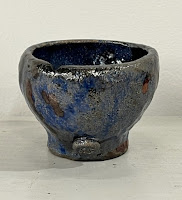
Showing posts with label glazing. Show all posts

Saturday, 9 April 2022

Sgraffito dish - glazed

 A few weeks ago I took part in this collaboration - it was part of a tutorial to learn Sgrafitto.

I designed the middle part of the pattern using Sacred Geometry, then I carved it into the clay.

Other decoration was added by other students and some mark making too.


So, I was lucky enough to be allowed to keep it, as long as I glazed it and fired it – well, I was more than happy to do that!

I used a clear earthenware glaze, which was a little disconcerting as it turned the whole thing white!

Then off to the kiln it went to be fired at 1100 degrees.
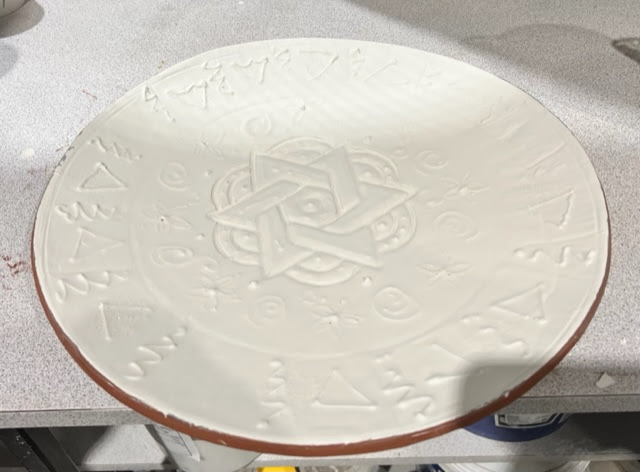

The finished piece is fabulous!  I love the depth of colour that the stained slip gives, much better than experimenting with glazes I think.

I really enjoy this process and can see me taking it a lot further.


Friday, 8 April 2022

Triaxial Blending

Today we did some Triaxial blending onto test tiles.

I really enjoyed this process – and as I am rubbish with numbers  (Dyscalculia) I created a little colour chart to help me along next time.


Working with my uni buddy Amanda, we chose some glaze recipes to make up and use.

We chose a white, a lilac and a green.


All mixed up and ready to go!


Next step was to get 21 different cups and number them.

Then we put the glazes in – 5 parts in each cup, according to the chart above.


The next thing was to pour it onto some prepared test tiles.

These tiles were terracotta, with a strip of white porcelain slip painted down the centre, textured and numbered.

This shows how the glaze looks on different clay bodies, along with how it pools into the textured grooves.


I poured one coat across half the tile, then another coat over half of that, so the tile would then show how different coats would look.

All 21 tiles complete, with an extra tile with an equal mix of all three glazes, and an extra tile with no glaze at all.


So, the finished tiles are not quite as exciting as I hoped, the green and the lilac don’t come through that well.   But that is the beauty of testing your glazes.

It does make a really interesting experiment though, and I am going to do it again soon with some stronger colours.


Monday, 14 March 2022

Glazing Ugly Pots

 I had a couple of pieces of hand built pottery that I wasn’t particularly over happy with, so I thought I would use them as glaze test pieces.

This has taught me that I really need to make all of my own glazes and test them properly, as this piece stuck to the kiln shelf as the glaze ran so much!

At Uni we have a system that nothing goes in the bin and we are encouraged to use any left over glazes from other peoples projects, should we wish to do so – the issue with that is you never know what you’re going to end up with.

With this one I dipped one half in one colour and the rest in another colour, then splashed it for added effect.


It’s still ugly  😊

But, it’s all a learning curve.


Sunday, 27 February 2022

Raku Firing Glaze Results

We made our own Raku glaze for firing….

Description: Satin, smooth, light blue iridescent surface.


  • 80 parts Borax Frit
  • 15 parts Ball Clay
  • 4 parts Tin Oxide
  • 1 part Bentonite
  • 1 part Cobalt Oxide
Results:

Shown as raw clay, glazed ready for firing, Raku fired.


The next glaze I used was one I found on the shelf in the glaze room – we are encouraged to leave our spare glazes for others to use, and to use any leftovers.   There was no recipe printed on this glaze so it was a case of pot luck with how it might turn out.  Not sure I like the bright green, but it is certainly very vibrant!


Tuesday, 22 February 2022

Trying out some Glazing


After a lesson on Glazing today, we were encouraged to try out our own recipe glazes.  This was quite exciting, like a cross between a chemistry and a baking lesson!

We chose this recipe to try – it was supposed to be an ‘opaque speckle glaze’.

  • 30 parts of Feldspar
  • 10 parts of Feldspar (soda)
  • 10 parts of Calcium Borate Frit
  • 8 parts of Dolomite
  • 14 parts of Talc
  • 8 parts of Ball Clay
  • 20 parts of Flint

The pots that came out of the kiln were totally different, might be the position in the kiln, or the thickness of the clay – every little difference makes a difference.